Features

Benedict XVI and the lament of the hawks

Tuesday, April 10th, 2012

Three decades ago, Cardinal Joseph Ratzinger rose to fame as the architect of the Vatican’s crackdown on liberation theology in Latin America, which he saw as a dangerous baptism of Marxist class struggle. That stance made Ratzinger a hero to anti-communist stalwarts everywhere, the perfect intellectual complement to John Paul II’s muscular challenge to the Read more

Discrimination, little freedom: One million Christians ‘hidden’ in Arabia

Tuesday, April 10th, 2012

It is a phenomenon not often spoken about; but the Arabic peninsula, homeland of Islam, pullulates with Christians. For most of them the next few days will be a rare and limited moment of visibility, after which they return to living a very discreet life of faith. It is almost a subterranean community in Saudi Read more

Revelations shed new light on Bishop Bill Morris dismissal

Tuesday, April 3rd, 2012

Some Catholics think last year’s dismissal of William Morris as Bishop of Toowoomba is just a storm in a teacup about a recalcitrant country bishop, and that it is time we all moved on. This is a serious misreading of the signs of the times. Church structures need to be reformed to be more aligned Read more

Kierkegaard re-contextualized: the agony of Pontius Pilate

Tuesday, April 3rd, 2012

This is the second in a three-part series examining the theological ideas of Søren Kierkegaard through the work of three contemporary church critics. The first part can be found here. To me, the most memorable voice in the St. John’s Passion has always been that of Pontius Pilate. After struggling fruitlessly to undo the inevitability of Read more

The half century challenge of John XXIII

Friday, March 30th, 2012

In 1962, I moved from the Brigidine Convent at Indooroopilly in Brisbane to St Joseph’s College, Nudgee Junior, under the care of the Christian Brothers. I was an impressionable eight-year-old and was in grade 3. I well recall one of the brothers taking the class up to the top floor of the school. We gathered Read more

Special Report: Conflict and Confusion in Cuba

Friday, March 30th, 2012

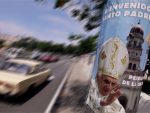
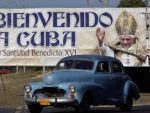
As Cuba prepared to receive Pope Benedict XVI on March 26, an increasing number of voices both on the island and abroad are complaining that the local church authorities are ignoring dissident groups and showing favoritism to a government that oppresses its own people. They also fear that the pontiff’s visit could be exploited for the same purposes.

In recent days, Lech Walesa, the former leader of Poland’s Solidarity movement that toppled the communist regime in 1989, as well as Cuban-American congresswoman Ileana Ros-Lehtinen, have joined Cuban dissident groups to ask the pope to speak out against human rights abuses by the island’s communist government during his upcoming trip.

The Cuban authorities have added fuel to the fire during the past week by temporarily arresting human rights protesters and other dissidents, including seventy members of the Ladies in White, which consists of the wives and female relatives of political prisoners. Thus far, requests by the Ladies in White to meet with Pope Benedict during his trip have not been answered.

Seeking to take advantage of the publicity surrounding the pope’s visit, a group calling itself the Republican Party of Cuba occupied several churches in the dioceses of Havana and Holguin on March 13. The group’s spokesman says that they were trying to “call the attention of the pope” to their cause, which they characterize as “liberty, democracy, and respect for human rights.”

Although the dioceses of Havana and Holguin deny that they asked for police intervention, the Havana protesters were ejected by government authorities by force two days later, after the archdiocese informed the police of the situation. The Republican party of Cuba complains that its members were handled roughly, and that the Bishop of Holguin behaved towards them in an insulting manner when asking them to leave, an order that was peacefully obeyed.

The Archdiocese of Havana accuses the dissidents themselves of attempting to use the pope’s visit for political purposes, claiming their actions are based “on a strategy prepared and coordinated by groups in various regions of the country.”

“It is not a chance event, but rather a planned one, apparently with the purpose of creating critical situations as the Pope’s visit approaches,” the archdiocese stated in a press release published by Granma, an organ of the government.

Read the article...
One woman’s inspiring journey to Catholicism

Tuesday, March 27th, 2012

For Kanako Ota, a resident of Sakai City in Osaka, this year’s Easter Vigil on April 7 will be a uniquely momentous occasion. For that is the date when she will receive the sacrament of Baptism. “My parents are professed Buddhists, but I had a feeling I would end up being baptized. I even told Read more

Unusual study asks former Catholics why they left church

Tuesday, March 27th, 2012

WASHINGTON — In an unusual study whose main results were released at a Catholic University of America conference in Washington Thursday, Villanova University in Philadelphia asked former Catholics in the Trenton, N.J., diocese why they left the church. While the results themselves were not surprising, the researchers said, the study suggests new ways the church can Read more

Unusual study asks former Catholics why they left church

Tuesday, March 27th, 2012

In an unusual study whose main results were released at a Catholic University of America conference in Washington Thursday, Villanova University in Philadelphia asked former Catholics in the Trenton, N.J., diocese why they left the church.

While the results themselves were not surprising, the researchers said, the study suggests new ways the church can approach Catholics who are dissatisfied with what the church teaches or how it acts — including those so dissatisfied that they have decided to leave.

One of their key recommendations was for pastors, bishops and other church officials to respond consistently to questioning or angry Catholics with constructive dialogue rather than a simple reiteration of church rules or policies.

Jesuit Fr. William J. Byron, a professor of business at St. Joseph’s University in Philadelphia — who collaborated in the study with Charles Zech, founder and director of the Center for the Study of Church Management of Villanova’s School of Business — several times cited a response of one disaffiliated Catholic who complained, “Ask a question of any priest and you get a rule; you don’t get a ‘Let’s sit down and talk about it’ response.”

Byron and Zech told conference participants at The Catholic University of America that many of the responses from lapsed or disaffiliated Catholics in the Trenton diocese matched what researchers have known from other surveys: They object to what they see as the church’s unwelcoming attitude toward gays and lesbians or toward the divorced and remarried, they find homilies uninspiring, the parish unwelcoming, the pastor arrogant or parish staff uncaring, or they have suffered terrible personal experiences with a priest or other church official, such as rejection for being divorced.

Some of the former Catholics complained of priests being too liberal, while others cited “the extreme conservative haranguing” they heard in homilies – reflecting the intra-Catholic political divisions that reflect similar divisions in the broader U.S. society


Read the article...

Memories of two kings of Tonga

Monday, March 26th, 2012

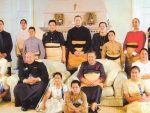
2 June 1953. Coronation Day. Two schoolboys, making the most of our day off from classes, joined the thousands lining the processional route hoping to get a glimpse of Queen Elizabeth II on her way to Westminster Abbey. We waved our Union Jacks like windmills and were proud when an elegant carriage stopped briefly near Read more